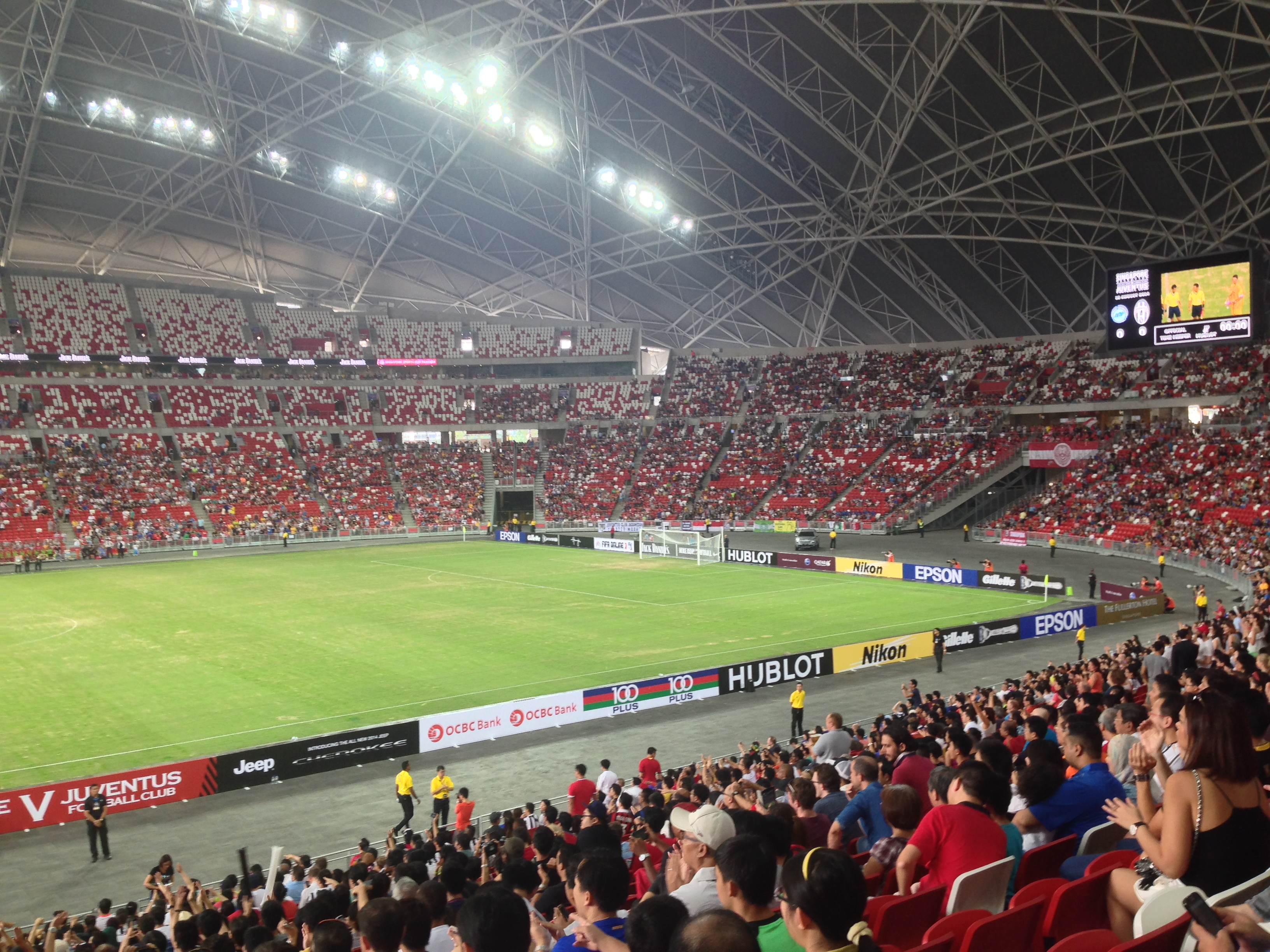
National Stadium: Juventus v.s Singapore Selection
It was your big day, first football match in history of the new you.
This time round, never mind you were half-filled with tickets holder and free loaders, it’s still quite a carnival. People lining up for long queue of hot dogs, Cold beers and fries.. pockets of Juventus fans scattered around, and die hard Singapore fans wearing reds from corner, attracting curious eyes from onlooker (I supposed it’s a rare breed being a died hard Singapore Lions fans nowadays).
The match ended at 5-0 I’m sure you tried your best to entertain us, although I must said your pitch looked awful. We saw glimpse of Pirlo free-kick, Progba’s sizzling run, and we participated in random acts of Kallang wave, trying hard to reminisce the good old days,
And yes, the good old days they were. And how I missed them..
You cheered with us when Sundram did that fake side step passed for Fandi to score and cried when Lim Tong Hai scored the infamous 2 owned goals, And remember that famous match? The same old you that went into berserk when Singapore thrashed Brunei 7-0. In that classic match, which Alistair Edwards score one of the quickest goal in Malaysian League, Sundram (again) did the famous bicycle kick and Steven Tan score the minute he came in as sub, all in one match, and most importantly, I was there.
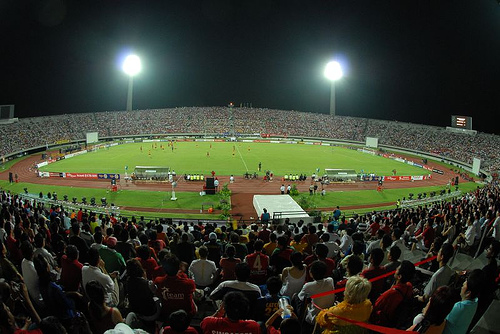
Good old Kallang Stadium
And good old you, where are the Curry Puff boys now? Who used to stroll around during match, selling curry puffs and drinks, and when match started, the boys would just sit along your pathway, watching the match. How they managed to enter is still mystery to me.
And that Milo Drink Stall, which sold the best Ice Milo in town- the super-diluted version.
And the Airhorn 9 times plus “Butuh” Chant. Did you remember that?
And long walk back to Kallang MRT. After each match, the long walk back to Kallang MRT could be either a dreadful walk when lost or celebrated march when won.
But well, the good old you has gone now so I need to start getting used to the new you, with new shopping malls and climbing walls.
I’m sure someday you will win over me, with stories of your own, of celebration and joy, of despair and disappointment. Someday…
Since the world pour with love and stories for Robin Williams, I think I should too to get certain attention, and possibly traffic to my humble blog.
First, let me start with a moment of silence for Robin Williams (BTW, if you happened to live in cave and happened to read my blog the first thing you are able to connect to wifi, he passed away yesterday. And please close this blog and get a life if you don’t know who he is.. though you seriously need to get a life anyway if you live in cave and happened to read my blog the first thing you able to connect to wifi)… Ok. moment of silence starts…
Thanks. Hope you still around.. I mean you, the reader, not Robin Williams, but wait, that’s not what I mean, I mean I hope he is around too. Ok. Whatever.
Please close this blog (again, I mean not again since you can’t close the blog twice) if you expecting any story on close encounter with him as a person, as I’m really just one of his fans (I live in Singapore and he is in US and the possibility of us meeting and have some meaningful life changing, heart melting, world celebrating conversation is almost zero) , but he is one of my favourite comedian actor, he really is. The other two of my favourites are Jake Black and Bill Murray.
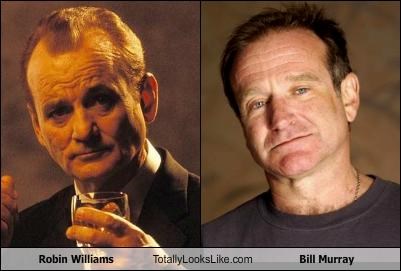
And talking about Bill Murray, I have to admit that when I was a kid, I can’t really tell the difference between Robin Williams and Bill Murray, not that they look the same, but they do have similar face structure and both are Ang Mo (Caucacius in Singlish) comedian. Imagine my conversation as a kid would be “Isn’t Robin Williams the one of the guys in Ghost Buster? I love him!” The enlightenment that make me realise that they are different person is the GroundHog Day movie, cause that’s the movie that has the repeat until loop scenes that the image of Bill would forever implant on me. And yes, GroundHog Day is indeed my favourite movie of Robin Williams.
Quick search on the Internet and seems I’m not the only one having the same childhood problem.
But at least I’m much better than the kids nowadays who thought the guy who gone was Robbie Williams (and probably this will kick start his career once again).. Seriously?
And talking about death. Ain’t it strange as we, human being, react to death, as if death will never fall upon us, that only on death, we remember all the good deeds, wonderful things that the person did in his life, and only upon death, we start to google search the best quote he has quoted, and watch on youtube the best movie scenes he has acted on. It’s happening to Michael Jackson, Whitney Houston, Leslie Cheung, Heath Ledger.. the list goes on.
So I have an idea.. my instruction for you now is to pre-emptive the death (like how Bush pre-emptive the war), and by quoting and tweeting and show your appreciation to celebrities, starting with Bob Dylan, Paul Simon, Morgan Freeman, Clint Eastwood, Mike Jagger, Dalai Lama and Ray Charles, few I can think of who the probability of them leaving us within the next 10 years are much higher than say, Justin Bieber (Which blog will be completed without mention of him). FACE THE FACTS, you need to face Justin Bieber for the next 60 years! He will continue to be everywhere. Tabloid, social media, TV, unless you hide in the cave. He is only god damn 20. (Are you still there? I hope you will not sink into depression after hearing this. Call American Association of Suicidology · Call 1-800-273-TALK (8255) if you need to talk to someone NOW.
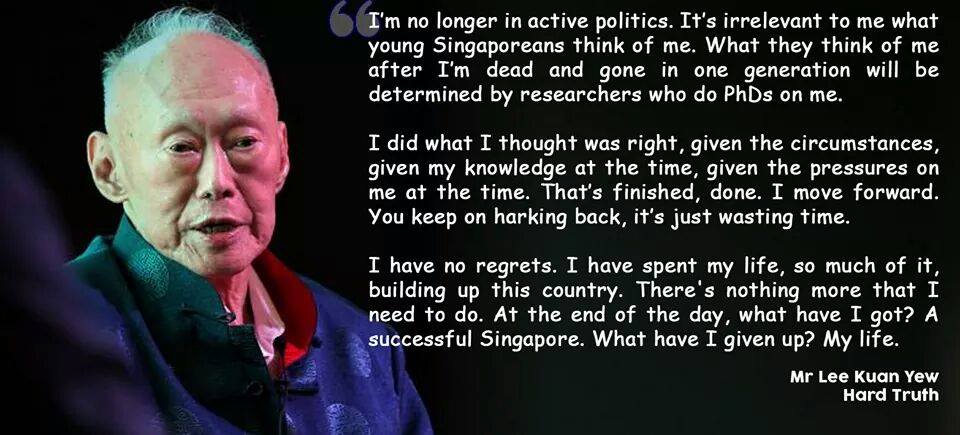
Ok. Enough of Justin, back to the pre-emptive the death that I mention, so if you start seeing me quoting “Get busy living, or get busy dying.- Morgan Freeman”, I’m doing the pre-emptive the death. And sorry to break the news, Morgan Freeman is already 76 and Lee Kuan Yew is already 90 (Did I mention him?) ! NO!
But still I must, finally, pay tribute to the man, Robin Williams. The world has lost a great actor, who touch many hearts through his movie. We don’t have much heroes to celebrate or mourn in this generation (Ah yes, Steve Job was the last I can remember), and the void is well replace by celebrities who we touch, see, smell every other days. I know that I will not blog about death of hundreds in Gaza, Iraq, Ukraine, Syria, or the death of those due to Ebola outbreak, they are too complicated for me..
Ok, back to Robin again, here are some of favourites tweets on him:
One of the sick children in the movie “Patch Adams” reflects on what it was like to work with Robin Williams. http://t.co/IeePNeCN3o
And last before I end the blog, please remember to do the most important pre-emptive the death, to our parents, loved ones, families and friends, one day they too will be gone. So please switch off the computer screen, tablets or iphone, and give your loved ones a big hug of love, appreciation and everything.
Recently, I had the privilege to take up the role of “Ah-Counter” for the recent chapter meeting in my Toastmaster Club. Simply, Ah-Counter’s role is to count the number of pause fillers that the speakers utter in their speeches. At the end of the meeting, I, as Ah-Counter, will give an Ah-Counter report, indicating the number of pause fillers each speaker made.
In linguistics, a filler is a sound or word that is spoken in conversation by one participant to signal to others that he/she has paused to think but has not yet finished speaking…. Different languages have different characteristic filler sounds; in English, the most common filler sounds are uh /ʌ/, er /ɜː/ and um /ʌm/. Among youths, the fillers “like”, “y’know”, “I mean”, “so”, “actually”, “literally”, “basically”, “right”, “I’m tellin’ ya” and “you know what I mean?” are among the more prevalent. Ronald Reagan was famous for answering questions starting with “Well…”
P&G’s not so recent announcement of buying majority of their Media programmatically, got me ponder a question to media agency industry: With the continue growth of programmatic investment, is brand moving (or at least thinking of) their media buying in-house through setting up of internal trading desk? I don’t have the any statistic with me though anecdotal evidences did suggest that this may be the case. Coincidentally, I recently did know of one financial company investing heavily to beef up their internal capabilities on Paid Search and Programmatic.
With the maturity of the ad-tech and brands getting more savvy in programmatic buying, I’m sure the reasons of moving in-house are enticing and warrant a long term thinking. Just to name a few potential advantages:
It’s interesting that SAP Development Day coincide with some of the Advertising Industry Event this week, starting with ATS Singapore 2014 (Don’t ask me the meaning of the abbreviation) on Monday, Ad Tech 2014 on Tues/Wed and World Federation of Advertisers Meeting (A full-day sharing session with various marketers in the industries, and no, it’s not a full-day bashing sessions on agencies. More on that later :)) on Thursday.
Courtesy of SAP Programmatic Platform Vendor DataXu, I managed to attend the ATS Singapore 2014. The ATS event gathered the industry players in the programmatic advertising space, with key topics surrounding jargons such as “programmatic”, “real-time bidding (RTB)”, “Demand Side Platform (DSP)”, “Data Management Platform(DMP)”.
Recently, I bumped into a blog post by Laurie McCabe, pointing out 5 things SAP needs to do to make simple real. To quote one of points in the article:
[Quote]
Stop saying SAP is ‘the’ cloud company
Unfortunately, this is a statement SAP executives made numerous times at the event, which, as I tweeted, had heads exploding at the likes of Salesforce and NetSuite! While SAP is aggressively moving to the cloud, it is getting there much later than these pure-play, born on the cloud companies. In addition, what’s the upside of even trying to stake this claim this late in the game? Though the puck is certainly moving to the cloud, survey after survey suggests that a hybrid IT environment will be the norm for most companies for a good long while. Positioning its ability to give customers choice is a much more believable and viable path for SAP.
[/Quote]
Eyebrows rose or a glimpse of smile?! I’m not sure if we are 100% agree with what she said, though I do see her point of view.
With all the focus surrounding Pull Marketing, Inbound Marketing, Content Marketing, many times Paid Media (banners, advertising) seems so “uncool”. In the world of inbound, we love our content to be organic searchable and viral spreadable. We crossed-finger that our content will be read and retweeted, and salivated by thousand fans. However realistically, a quick look at our omniture traffic shows that 70% of SAP visitors never go beyond 2nd pages, and industry study shows that live span of twitter post is less than a coffee break (18 minute to be precise). As marketers, of course we love to create that OREO moment but, anecdote evident suggest that this type of “Oscar Award” kind of campaigns happen only once in blue moon and more often than not, we still need to spend some $ to ensure we maximise our reach to target audience.
Recently, I attended the IMC Forum organised by WFA, which various brands (clients) get together for a session talking about various marketing topics.
One key topic is on programmatic buying, and more specifically on Trading Desks.
So what exactly is Trading Desks? There is a good whitepaper by Forrester defines as follow:
A centralized, service-based organization that serves as a managed service layer, typically on top of a licensed demand-side platform (DSP) and other audience buying technologies; manages programmatic, bid-based media and audience buying. Works as an agency’s internal “center of excellence,” supporting agency teams wishing to tap into this new buying model on behalf of agency clients.
Sound alien? Basically, it’s a team that setup to help clients to buy and manage media through programmatic buy, rather than traditional form of media buying, through publishers. This team can be managed within client’s media agency, known as Agency Trading Desk (ATD) (For e.g., for Mindshare, Xaxis is the agency trading desk that help to do programmatic buy), or independently setup, known as independent trading desks (ITDs).
A survey results on Trading Desks was shared during the forum and here are the executive summary :
Majority (81%) of respondents are using agency trading desks while a minority (11%) are using independent trading desks
But satisfaction with ATDs (transparency and charges) is significantly lower than ITDs
Trading desks currently accounting for 6% of total online display media budgets on average, but accounts for much higher share for some membersTrading desk use of client data a concern for 54% of respondent but only 30% have made provision in contracts to access or secure it
Overwhelming majority (83%) feel trading desks are less transparent than ‘traditional’ way of trading
And 54% been asked to sign separate contracts to the rest of media activity
Just 13% satisfied with level of transparency into how ATDs charge for audience buying services
Few solutions to this but main focus on moving to use services of an independent
ITDs generally regarded as more transparent (50% satisfied with transparency into how charge for services)
Most respondents (57%) aware that “arbitrage” (Buying ad spaces at a low price and selling them to media buyer at much higher price) is happening and 82% suspect it influences the impartiality of recommendation.
The majority (64%) do not accept “arbitrage”, even if receiving improved value compared to „traditional‟ way of trading
Despite these challenges, 73% of respondents expect trading desk budgets to increase for display media and 66% say the same for online video
This planned growth is likely driven by the potential for lower CPMs, cited by 65% of respondents, and improved ROI, mentioned by 31%
Here are few more articles that debates the model of agency trading desks. See here and here.
There have been a lot of discussion around “always-on ” for past few months within the B2B marketing community, and how marketers today need to shift from a “campaign” mindset to an “always-on ” mindset – with “always-on ” taking on more prominent role, I would like to share a few thoughts on building an “always-on ” Media strategy. (I shall remove the quotation mark to highlight it’s coming of age.) To start off, let me illustrate a common practices when we run a typical B2B campaign for demand generation:





 ecent chapter meeting in my
  got me ponder a question to media agency industry: With the continue growth of programmatic investment, is brand moving (or at least thinking of) their media buying in-house through setting up of internal trading desk? I don’t have the any statistic with me though anecdotal evidences did suggest that this may be the case. Coincidentally, I recently did know of one financial company investing heavily to beef up their internal capabilities on Paid Search and Programmatic.
 Wherever I may roam